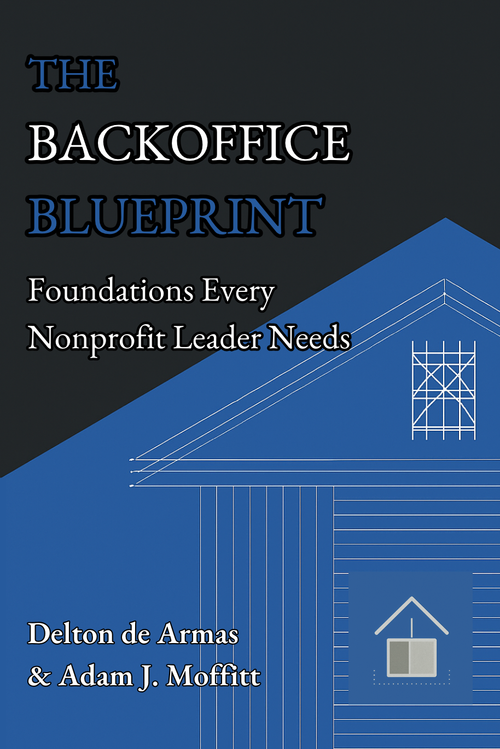
About the Book
I wrote the playbook I was trying to follow.
Years before this book existed, I taught a workshop on church accounting at a national conference. It went well. People filtered out. I saved the notes to Dropbox and forgot about them.
Then I launched Qavah Ministries with my wife, and found myself on the other side of the equation. Not the consultant in the room, but the leader searching for answers. The same financial systems I once helped others understand, I now needed. I pulled up those old notes. And I realized the content still worked, and that the principles were not just for churches using a particular software platform. They applied to any mission-driven organization trying to build something that lasts.
That is how this book was born. Not from theory, but from the other side of the desk. From consulting boardrooms and from sitting in budget meetings wondering if the systems we had built would hold.
Adam Moffitt came alongside this work and strengthened every chapter. Between us, we bring more than five decades of financial leadership in nonprofit, church, and corporate settings. We have sat at the CFO’s desk, the board table, and the consultant’s chair. This book is what we wish someone had handed us earlier in our careers.
“Here’s to building something beautiful, especially the parts no one sees.”
Preface, The Backoffice Blueprint
The Framework
Five pillars. Plain language. A framework that actually holds.
The book is organized around five areas that determine whether a nonprofit or church’s financial systems can sustain its mission. Each chapter ends with a Blueprint Note summary and an Inspection Points checklist your team can act on immediately.
Foundations
Governance, policies, role separation, and the structural decisions that shape everything else. This is where the gaps tend to run deepest.
Disbursements
Spending controls, expense approval, payroll, and vendor management. Where money goes out, and how to make sure it goes out right.
Receipts
Donation handling, restricted gifts, donor acknowledgment, and revenue integrity. How money comes in, and how to steward it faithfully.
Reporting
Financial statements, board packets, and how to present information that non-financial leaders can actually use to make decisions.
Implementation
Documentation, staff training, and how to build systems that survive turnover. The pillar most organizations skip, and the one that makes all the others stick.
Who This Book Is For
You do not need to become a financial expert. You need to understand the terrain.
Executive Directors
You oversee financial staff but did not come up through finance. This book gives you the language and the framework to lead that function with confidence.
Board Members
You review financial reports but are not always sure what questions to ask. This book changes that, making you a more effective steward of the mission.
Church Administrators
You are building financial systems for a growing congregation, often without a roadmap. This book is that roadmap.
Finance Staff
You are new to the nonprofit or church sector and need to understand how this world works differently from corporate finance. This book bridges that gap.
Consultants and Advisors
You work with nonprofits and churches and want a framework that gives your clients a shared language for the financial work. This book is that shared language.
Volunteer Treasurers
You stepped into a role without formal training and are figuring it out as you go. You are not alone, and this book was built with you in mind.
Free Resource
Not sure where your gaps are? Start with the free checklist.
The Financial Health Assessment covers the same five pillars and takes about five minutes. You will get a clear picture of where your systems are solid and where the work is, before you buy the book or bring in any outside help.
Free Assessment
Nonprofit Financial Health Checklist
25 questions across five pillars. Interactive checklist with pillar-by-pillar scoring. Downloadable PDF version available. No email required to use it.
About the Authors
Written by practitioners, not theorists.
Keep Going