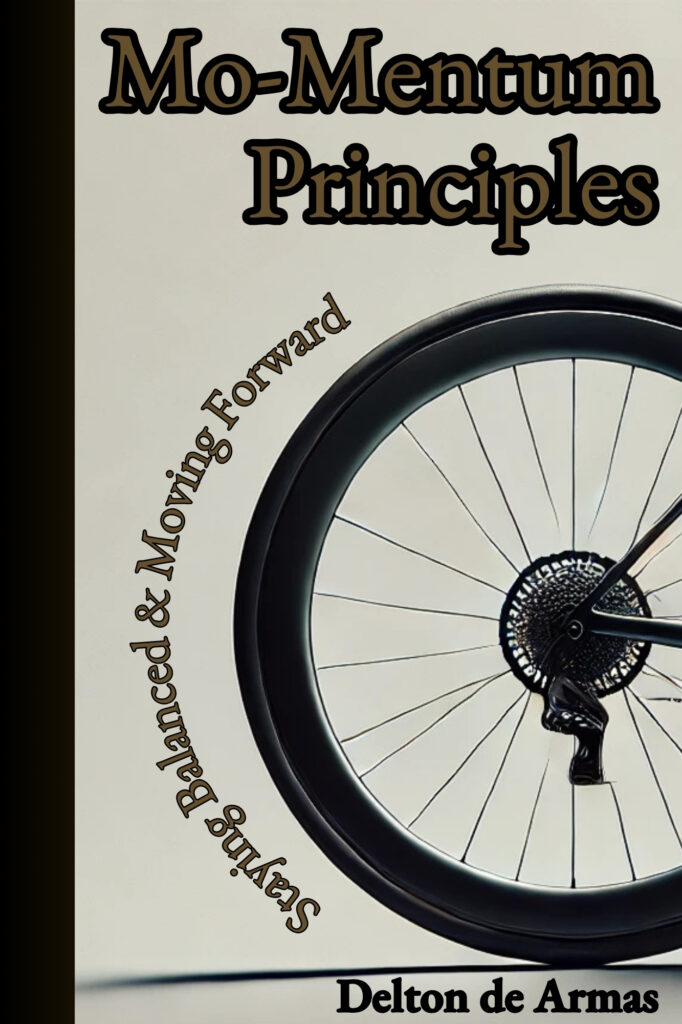
About the Book
I spent thirty years explaining financial statements. This book is what I wish I had written first.
After more than thirty years as a finance executive, I had explained cash flow to hundreds of business owners. The technical definitions were accurate. The spreadsheets were meticulous. And none of it produced the moment of real understanding I was looking for. I kept seeing glazed eyes and polite nods.
Then one day, in the middle of a client conversation, something clicked: the cash flow statement is simply looking at the balance sheet change over time. That was it. Simple, clarifying, and obvious once you see it. The question was how to make it stick for someone who thinks in motion rather than in ledgers.
My friend Adam, knowing my tendency to tell stories, suggested a parable. And cycling, my lifelong passion, offered the right metaphor. On a bike, financial concepts suddenly made sense. Cash flow became momentum. Balance sheets became terrain. P&Ls became effort over distance. The abstract became something you could feel in your legs and lungs rather than just calculate in a spreadsheet.
The result is Greg and his Uncle Mo: a young entrepreneur starting a lawn care business, and the seasoned businessman who teaches him everything he needs to know over the course of a year and nine rides. I did not set out to write a book that would make people cry. But I have learned not to be surprised when it does.
“Money is never the ultimate destination. It is just fuel for the journey toward what truly matters.”
Uncle Mo, final chapter of Mo-Mentum Principles
The Metaphor
Financial concepts you can feel in your legs.
On a bike, the abstract becomes tangible. Here is how the language of the book maps to the language of business.
The Journey
Nine rides. One year. A business and a perspective transformed.
Each chapter follows Greg and Mo on a ride that teaches one financial concept. The chapters are named for the terrain, not for the topic.
Chapter One
The Start
Greg calls Mo with a lawn care idea. Mo hands him a worn notebook and says: figure out how long you can go without getting paid. Most people never ask that question.
Chapter Two
Finding Your Balance
The P&L statement. What it shows, what it hides, and why a profitable business can still run out of money.
Chapter Three
Reading the Trail
The balance sheet. How to read the terrain ahead and understand what you actually own versus what you owe.
Chapter Four
The Flow
The cash flow statement. The insight at the heart of the book: it is simply the balance sheet change over time. Once you see it that way, you cannot unsee it.
Chapter Five
Right Gear, Right Time
Timing decisions. When to invest, when to hold back, and why working hard in the wrong gear wastes everything you have.
Chapter Six
The Long Climb
Scaling the business. How to grow without losing your footing, and why the climb requires a different kind of attention than flat ground.
Chapter Seven
Weathering the Storm
Crisis management. What to do when conditions change without warning and you are already midway up the hill.
Chapter Eight
The Scenic Route
Long-term thinking. The view from higher ground, and what becomes visible about your business when you stop riding with your head down.
Chapter Nine
The Return Journey
One year in. Greg reviews his financials with fluency he did not have before. Mo reminds him that applying what you have learned, consistently, over time, is the hardest part of the journey.
What Readers Are Saying
A finance book that makes people cry. I did not see that coming either.
“Well, who would have thought a book on finance would make me cry. Just completed the final chapter this morning in the quietness of my farm as the sun rose. What a special gift the author has given to me and the world. My digital copy is filled with highlights from start to finish. It read to me like a Jon Gordon book using parable and spirit to teach principle. I have restored hope in reclaiming some of my professional story and personal as a result.”
Rebecca
Amazon review, five stars
“In twenty pages, Mo has made me see and feel Uncle Nestor again. Brilliant. Even when someone reads this and never knew him, the character and presence he created will be felt by the reader.”
Seth
CPA, beta reader, and my nephew
Who This Book Is For
Anyone who has looked at a financial statement and thought: there must be a clearer way.
Where This Book Came From
A real relationship, a very fictional character.
A note from the author
Uncle Mo is fictional. But he was inspired by someone real. My uncle Nestor was a CPA and CFO who had a gift for asking simple questions that revealed deeper truths. Our conversations happened on ski slopes, not bicycle trails. His way of making complex ideas accessible through everyday experience is exactly what I tried to capture in Mo.
The cycling metaphor is mine. It is my lifelong passion, and the frame that finally made the financial concepts click for me the way I always hoped they would click for someone else.
I wrote this book for the people sitting across from me with glazed eyes and polite nods. For anyone who has ever felt like an outsider in a conversation about money. And, honestly, for Nestor. The best way to honor a gift is to pass it on.
Keep Going